1943
January
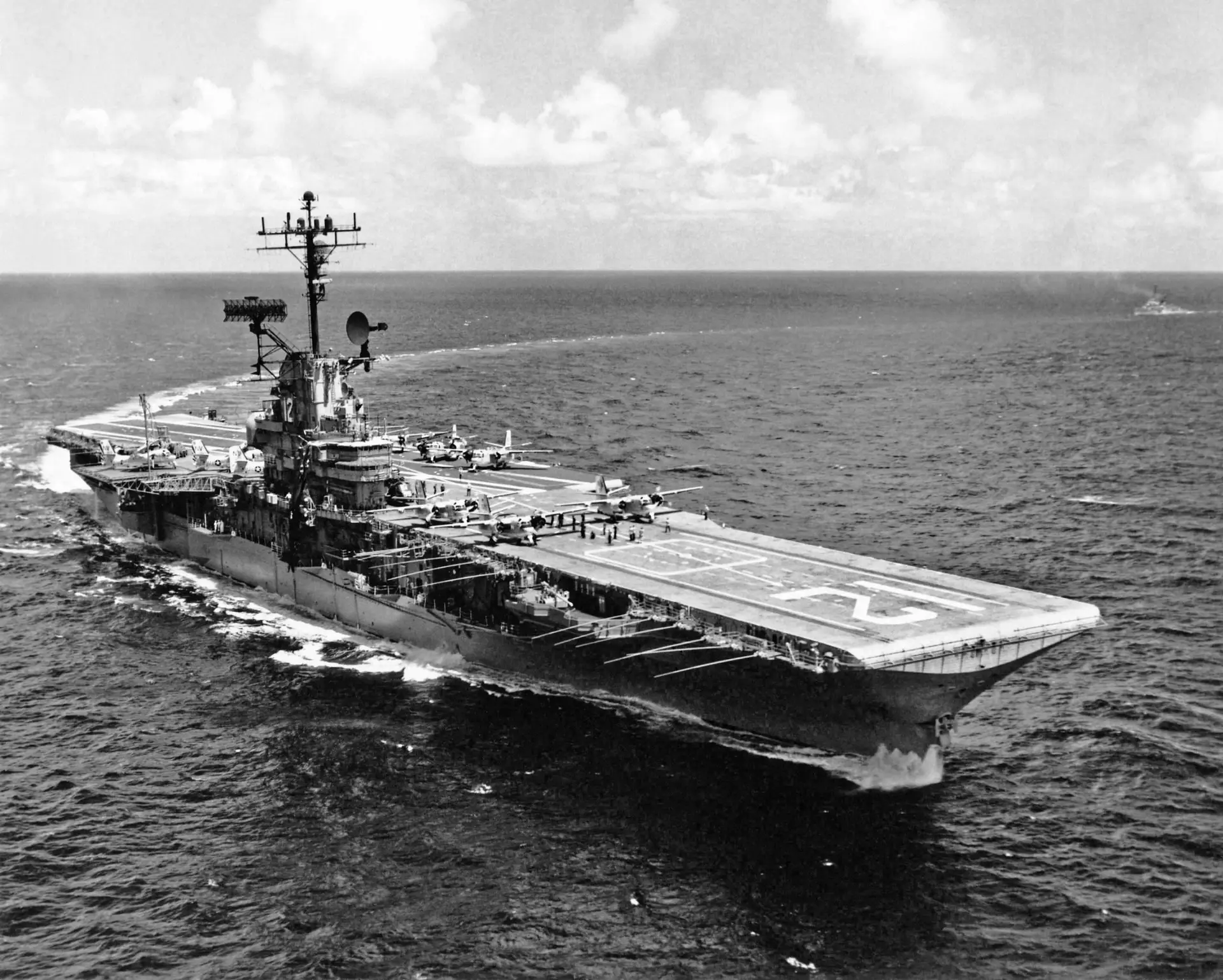
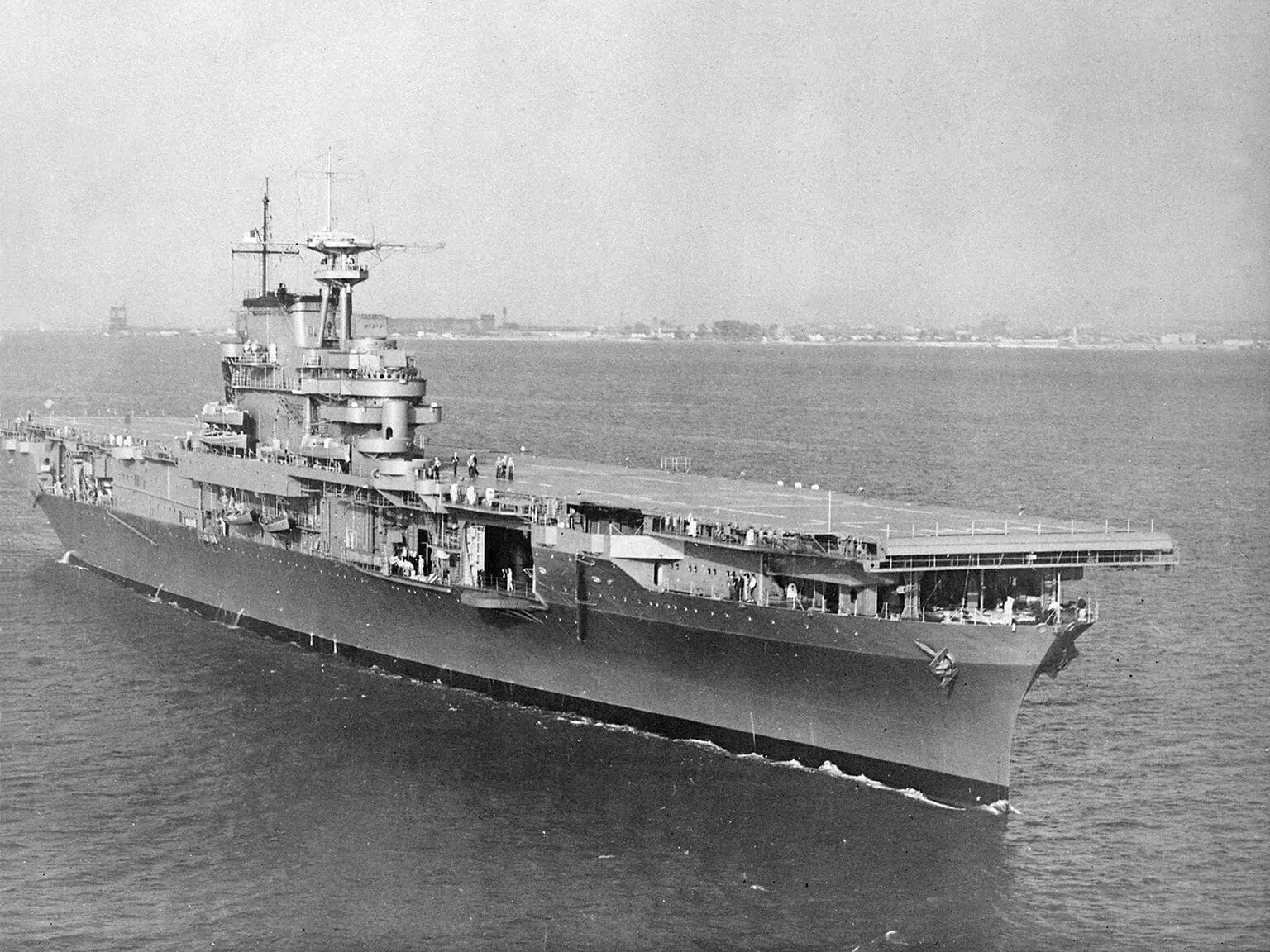
The Navy’s aircraft carrier hull number 12 was originally slated to be commissioned as the USS Kearsarge. However, the ship’s name was changed to honor the fallen USS Hornet (CV-8) after she was sunk at the Battle of Santa Cruz Islands while protecting US forces holding Guadalcanal. USS Hornet (CV-12) was commissioned November 29, 1943, becoming the eighth US Navy ship to bear the name.
1944
March 15
USS Hornet (CV-12) left Pearl Harbor en route to the forward area. Her combat debut as the flagship of Rear Admiral J.J. “Jocko” Clark came quickly as she joined famed Task Force 58.
June 19
Battle of the Philippine Sea where pilots from USS Hornet (CV-12) and other carriers destroyed enemy aircraft with minimal losses in what came to be known as the “Great Marianas Turkey Shoot”.
June 24
USS Hornet (CV-12) participated in the Western Carolina Islands operation with air support strikes on Peleliu.
September
USS Hornet (CV-12) air group VF-2 had the distinction of being the top US Navy fighter squadron in the Pacific with more total victories and more “ace” pilots than any other fighter squadron up to that time.
October 23-26
USS Hornet (CV-12) participated in the Battle of Leyte Gulf, launching 2 long-range strikes against a rapidly retiring Japanese fleet and scoring hits on several capital ships.
November
USS Hornet (CV-12) and Task Force 58 began intensive operations in the Philippines and surrounding areas. For the next two months, strikes were made against positions on Formosa, Luzon, Saigon, Cam Ranh Bay in French Indo-China, and Hong Kong.
1945
February 16
USS Hornet (CV-12) kept a date the old USS Hornet (CV-8) had made some 34 months before when she conducted the first carrier strikes on Tokyo, neutralizing air fields and hitting shipping and targets of opportunity.
June 5
The USS Hornet (CV-12) and crew weathered a severe typhoon that threw 120-knot wind gusts at the warship. The flight deck of the USS Hornet (CV-12) and her sister ship USS Bennington (CV-20) were heavily damaged and both were put out of action. Of note, the Hornet launched aircraft off the stern for a period of time.
July 7
USS Hornet (CV-12) steamed under the Golden Gate Bridge into San Francisco Bay. She offloaded planes and ammunition then entered dry dock at Hunters Point Naval shipyard for repairs from the typhoon.
September
After Japan surrendered, USS Hornet (CV-12) was used as a troop transport in Operation “Magic Carpet,” bringing veterans of the Pacific War back to the West Coast.
1946
August 14
USS Hornet (CV-12) returned to San Francisco and was designated an inactive part of the 19th Pacific Fleet.
1947
January 15
USS Hornet (CV-12) is decommissioned at Hunters Point, San Francisco.
1951
March 20
USS Hornet (CV-12) was recommissioned at Hunters Point after 4 ½ years. The carrier departed San Francisco and transited the Panama Canal en route to Brooklyn Naval Shipyard in New York.
May 12
USS Hornet (CV-12) underwent a significant modernization program in New York. Hornet’s 27-month, $50 million renovation, known as SCB-27A, gave her more powerful catapults and arresting gear, a strengthened flight deck, a new streamlined island, new ammunition lifts and numerous other improvements to facilitate the Navy’s new jets and heavy attack bombers. This program upgraded virtually every system aboard the ship and brought her to the forefront of carrier technology.
1952
October 10
USS Hornet (CVA-12) received the new designation “CVA” for attack carrier.
1953
September 11
USS Hornet (CVA-12) was recommissioned at New York Naval Shipyard.
December 8
During sea trials, USS Hornet (CVA-12) landed its first jet, an F2H-3 Banshee.
1954
May 11
Since USS Hornet (CVA-12) was based on the West Coast, the Navy returned it to California on an around-the-world cruise, via the Atlantic, Mediterranean, and Indian Oceans. The cruise lasted eight-months and ended in Manila Bay in late June when Hornet returned to the Pacific Fleet.
July 25
USS Hornet (CVA-12) fighters assisted in a search for survivors of a British Cathay Pacific DC-4 commercial airliner that had been shot down by two Chinese La-7 Fins fighters. The British airliner had crashed off the Chinese island of Hainan and Hornet pilots were able to locate several survivors in what became known as the “Hainan Incident.”
1955
During this year, the USS Hornet (CVA-12) conducted operations and training in the Pacific.
1956
January
USS Hornet (CVA-12) was ordered to Bremerton, Washington to start her next modernization, called SCB-125 by the Navy. While at Puget Sound Naval Ship Yard, Hornet was fitted with an angled flight deck.
June
Chinese anti-aircraft gunners shot at two USS Hornet (CVA-12) aircraft but, other than minor damage, both aircraft returned to Hornet safely.
July
USS Hornet (CVA-12) returned to San Diego and spent the rest of the year conducting training around the California coast before heading to the western Pacific.
August
Modernization was completed and also included the fitting of an enclosed hurricane bow. Following tests, training, and carrier qualifications, USS Hornet (CVA-12) departed for a six-month deployment with the 7th Fleet in the western Pacific.
1958
January
USS Hornet (CVA-12) left for another Western Pacific cruise.
June 27
USS Hornet (CVS-12) was re-designated an “anti-submarine warfare support” (ASW) aircraft carrier. Her CVS conversion was done at Puget Sound Naval Shipyard. In this configuration, the Hornet was the center of an anti-submarine warfare hunter-killer group.
1959
April
USS Hornet (CVS-12) departed for the Western Pacific in her new role as an ASW carrier. As an ASW carrier, one of the more noticeable changes was the addition of helicopters and piston-engine aircraft.
1960
March
USS Hornet (CVS-12) returned to Long Beach and started another WestPac Cruise.
1961
February
Returning to Bremerton, USS Hornet (CVS-12) was dry docked for four months.
November
USS Hornet (CVS-12) crewmen helped fight the famous Hollywood Hills fire that devastated the Los Angeles suburb. Hornet’s two diesel generators were used to feed electricity into the Southern California power grid.
1962
June
USS Hornet (CVS-12) started her seventh WestPac Cruise and returned to Long Beach at the end of the year where four of the remaining 5-inch guns were removed.
1963
April
USS Hornet (CVS-12) returned to Hunter’s Point to undergo another modernization and conversion called FRAM II.
October
USS Hornet (CVS-12) departed for her eighth WestPac Cruise.
1965
February
The conversion to FRAM II modernization was complete.
August
USS Hornet (CVS-12) departed for her ninth WestPac Cruise and first Vietnam cruise. Most of her time was spent supporting Navy and Marine aircraft on an around-the-clock SAR (search and rescue) mission. Her helicopters flew inland in support of strike aircraft while her assigned A-4E Skyhawks flew 110 combat missions off another carrier.
1966
March
USS Hornet (CVS-12) arrived back in San Diego and entered dry dock for overhaul.
August
USS Hornet (CVS-12) served as the Prime Recovery Ship for Apollo AS-202’s suborbital space flight. The unmanned capsule was recovered 205 nautical miles southeast of Wake Island.
1967
March
USS Hornet (CVS-12) left for her tenth WestPac Cruise and second Vietnam cruise. During this time, Hornet supported Seventh Fleet units in and around Vietnam and the Gulf of Tonkin. Hornet tracked Soviet submarines and was over flown several times by Soviet aircraft.
October
After several trips to Japan and Hong Kong, USS Hornet (CVS-12) returned to Long Beach.
November
USS Hornet (CVS-12) entered dry dock in Long Beach in late November.
1968
May
USS Hornet (CVS-12) left dry dock after a completed overhaul and departed for her eleventh WestPac and third Vietnam Cruise.
October
Arriving in the Gulf of Tonkin shortly after the bombing halt, USS Hornet (CVS-12) pilots conducted surveillance and ASW operations before stopping at Hong Kong and Japan.
1969
April
USS Hornet (CVS-12) returned to the US after a six-month tour of duty off the coast of Vietnam.
June
While still docked in its Long Beach home port in mid-June, USS Hornet (CVS-12) loaded initial NASA and news media equipment, such as satellite earth terminals on the flight deck and large TV tractor trailers in the hangar deck.
July 12
USS Hornet (CVS-12) departed Pearl Harbor, Hawaii to begin the 14 day Apollo 11 recovery cruise.
July 24
President Richard Nixon arrived onboard USS Hornet (CVS-12) an hour before the Apollo 11 spacecraft splashed down. Three hours later, after astronauts Neil Armstrong, Buzz Aldrin and Michael Collins, as well as the Command Module Columbia, had been safely recovered, Hornet was on her way back to Pearl Harbor.
Hornet mission change from war to recovery
In May 1969, the aircraft carrier USS Hornet CVS-12 returned to the US after a six-month tour of duty off the coast of Vietnam. Just weeks later, the U.S. Navy selected Hornet as the prime recovery ship for Apollo 11, still the most complex recovery in NASA spaceflight history. Once assigned to Task Force 130, which handled Pacific Ocean spaceflight recoveries, Hornet’s Commanding Officer Captain Carl Seiberlich also became the Commander of all recovery forces in the primary landing area.
While still docked in its Long Beach home port in mid-June, Hornet loaded initial NASA and news media equipment, such as satellite earth terminals on the flight deck and large TV tractor trailers in the hangar deck.
Motto: Hornet Plus Three
For the recovery operation, Capt. Seiberlich adopted the motto “Hornet Plus Three,” a safety message that all the personnel aboard the ship, plus the 3 astronauts, would return safely from the mission.
To Pearl
On June 26, Hornet headed to Pearl Harbor, Hawaii. After leaving port, 8 SH-3D Sea King helicopters from Antisubmarine Warfare Squadron 4 (HS-4) landed onboard along with 4 E-1B Tracers from VAW-111, and 2 C-1A Traders from VR-30. The USAF also had several aircraft supporting this recovery operation from bases in Hawaii.
After arriving at Pearl Harbor on July 2, a boilerplate Apollo capsule was craned aboard the ship to be used for recovery practice sessions called SIMEXs. The 35-member NASA recovery team, and roughly 140 media personnel were also brought onboard. The Hornet team consisted of 90 personnel who were given specific recovery assignments.
Protection from possible moon germs
A detachment of 12 swimmers from the U.S. Navy’s Underwater Demolition Teams 11 and 12 embarked as well. LT Clarence “Clancy” Hatleberg served as the detachment commander, as well as the decontamination swimmer (a completely new NASA requirement). Members of the UDT team had gained valuable experience with the Apollo 8 and Apollo 10 recoveries in the prior 6 months. Clancy had also participated in the NASA astronaut water egress training in the Gulf of Mexico in May and his team was determined to ensure success.
Two NASA Mobile Quarantine Facilities (MQFs) were also craned aboard Hornet. MQFs were heavily modified Airstream trailers designed to biologically isolate its occupants from the outside environment. The primary MQF would house the returning astronauts, a flight surgeon, and an MQF engineer after the splashdown until their arrival at the Lunar Receiving Lab in Houston several days later. The second MQF served as a backup should it be necessary for any reason.
On Station to the recovery spot
On July 12, Hornet departed Pearl Harbor, heading south to the equator. By July 16, the date of the Apollo 11 rocket launch, she was “on station” just east of the Phoenix Islands in case of a launch abort. After the spacecraft entered a lunar orbit trajectory, Hornet slowly steamed northwest towards the NASA selected splashdown site with a scheduled date of July 24.
During this 8-day period, Hornet conducted many SIMEXs, night and day, to ensure that every crewman understood his role and there was a trained backup for every potential problem that might arise.
On July 23, Hornet was “on station” at the primary landing site when NASA decided the weather conditions were unsafe there and relocated the splashdown point 240 miles northeast. Hornet refueled from the fleet oiler USS Hassayampa AO-145 and then sped northeast at flank speed through the night. Hornet arrived at the actual splashdown location 920 miles southwest of Hawaii at 1:30am the next morning.
The Recovery
The recovery activities of July 24 began before dawn. Hornet’s primary aircraft, consisting of 4 helicopters and 2 fixed wing aircraft, were launched by 4:45am, to clear the air space for the arrival of President Richard Nixon and his entourage. This HMX-1 helicopter transit was a short flight as the dignitaries had spent the previous night on the USS Arlington AGMR-2, just a few miles away. Marine One landed on Hornet’s flight deck at 5:04am. According to his Naval Aide, LCDR Charles Larson, the President greatly enjoyed his 3 hours aboard the ship.
The night sky was just starting to lighten as the Apollo 11 Command Module Columbia descended under its 3 giant orange and white parachutes. The spacecraft splashed down at 5:50am (ship time) about 12 miles downwind from Hornet. The astronauts reported via radio that they were in good shape. However, a gust of wind billowed the parachutes and tugged the spacecraft into a Stable 2 position, which means “stable – but upside down.”
Columbia’s uprighting system, 3 large inflatable bags, adjusted the spacecraft into a Stable 1 (upright) position in 8 minutes. Once the CM was upright, the first UDT swimmer jumped from his helicopter and attached a sea anchor to the CM, slowing down its drift rate in the high sea state conditions. Minutes later, two more UDT swimmers jumped from their helicopter to attach and inflate a flotation collar to the CM, as well as inflating two work rafts.
Hatleberg, the UDT decontamination swimmer, then jumped from the primary recovery helicopter #66 (call sign RECOVERY ONE). Once his decontamination equipment was dropped from the helicopter, he began the initial NASA quarantine process. As part of the quarantine program, NASA had created special Biological Isolation Garments (BIG) that would completely encase a human from head to toe. So, the first step for Clancy was to don his own BIG suit. He then opened the CM hatch and threw in three sets of BIGs that had been tailored to fit each astronaut.
When the hatch was opened again at 6:30am, the three astronauts egressed one at a time into the “decontamination raft.” Hatleberg helped them balance in the choppy seas as they stepped out – Neil Armstrong first, Michael Collins second and Buzz Aldrin third. After the hatch was closed and locked, Hatleberg used a wash mitt soaked in betadine to wipe the vents and hatch on the CM to kill any moon germs.
Then, Hatleberg turned his decontamination effort to the astronauts. Using a sodium hypochlorite solution (aka bleach), he wiped down the BIG suit of each astronaut. In turn, one of them wiped down his BIG as well. The first stage of the NASA astronaut quarantine process was complete.
RECOVERY ONE was then positioned 40 feet above the decontamination raft and lowered a Billy Pugh rescue net. Neil Armstrong, seated in the back of the raft, inserted himself first and was winched up to the open cargo hatch of the Sea King helicopter. Collins was next, followed by Aldrin. They were met by NASA flight surgeon Bill Carpentier who asked about their health. Once they were seated in the cargo bay, CDR Don Jones piloted helicopter #66 to a perfect landing on Hornet’s flight deck at 6:57am.
RECOVERY ONE was lowered by an aircraft elevator to the hangar deck and towed into position adjacent to, and 30 feet from, the primary MQF. Once inside, Armstrong, Collins, and Aldrin changed into NASA flight suits. Joining the 3 astronauts in “lock-down” were Dr. Bill Carpentier and the MQF Technician John Hirasaki. At 7:55am they proceeded to the window in the back of the MQF to be welcomed home by President Nixon, a ceremony that was broadcast on live TV to 500 million viewers worldwide.
At 8:50am, after the President left the ship for his worldwide tour, the Hornet team hoisted Columbia out of the water by crane and onto elevator 3, from which it was towed it to a spot next to the MQF. The CM hatch was connected to the MQF door by way of a hermetically sealed plastic tunnel. The astronauts and John Hirasaki then transferred photographic film, containers laden with 48 pounds of moon rocks, space suits and other items into the MQF. The moon rocks were put in special containers and passed out of the MQF via a decontamination lock and flown that day to the NASA Lunar Receiving Laboratory in Houston for initial evaluation.
Hornet Plus Three to Pearl
Meanwhile, Hornet set a course for Pearl Harbor with 5 people locked inside the MQF. Several medical tests were performed on the astronauts during the 52-hour transit, as well as having them record their personal recollections about the flight and catch up on world news.
Hornet arrived at Pearl Harbor Naval Base at 8:50am on July 26. The sealed MQF was soon lifted onto a USAF cargo pallet loader by a dock yard crane and transported 50 feet to a cheering pier-side crowd of 2,000 people including Honolulu’s mayor and a few Navy dignitaries. The pallet loader then carried the MQF to Hickam AFB where it was loaded in the cargo hold of a C-141 and flown to Houston.
Shortly thereafter, Columbia was craned off the Hornet’s flight deck and transported to a nearby hangar to be processed for its flight to Houston a few days later.
Mission Accomplished!
Navy contributions to the American space program made breakthroughs like Apollo 11 possible. The priority of the Apollo missions was not simply to put men on the Moon in the 1960s. President John F. Kennedy’s 1961 challenge also included the phrase “and return them safely back to Earth.” The USS Hornet (CVS-12) successfully completed one of the most momentous technological feats in all human history.
August
USS Hornet (CVS-12) returned to Long Beach with a banner proclaiming “HORNET PLUS THREE,” which declared them to be the recovery vessel for Apollo 11.
October
USS Hornet (CVS-12) Departed Long Beach for Hawaii as primary recovery platform for Apollo 12 mission.
November
USS Hornet (CVS-12) Departed Pearl Harbor for primary Apollo 12 recovery area to pick up the spacecraft Yankee Clipper, with its all-Navy astronaut crew of Pete Conrad, Alan Bean and Dick Gordon, splashed down a little over 2 miles from the aircraft carrier.
December
USS Hornet (CVS-12) returns to Long Beach, CA.
1970
January
The Navy announces USS Hornet (CVS-12) will be deactivated in June.
February
An S-2E Tracker makes last arresting landing aboard USS Hornet (CVS-12).
March
USS Hornet (CVS-12) begins deactivation at Long Beach, CA.
June
USS Hornet (CVS-12) decommissioned at Puget Sound Naval Shipyard, Bremerton, WA.
1989
August
The Navy ordered USS Hornet (CVS-12) stricken from the Naval register.
1991
December
USS Hornet (CVS-12) designated a National Historic Landmark by National Park Service. She is listed on the National Register of Historic places, #91002065.
1998
May 26
USS Hornet (CVS-12) was donated to the Aircraft Carrier Hornet Foundation.
October 17
USS Hornet (CVS-12) was opened to the public as the USS Hornet Museum.
1999
USS Hornet (CVS-12) was designated as a California State Historic Landmark.