Gemini Recovery and Apollo 13 Film
Burau Number: 148999
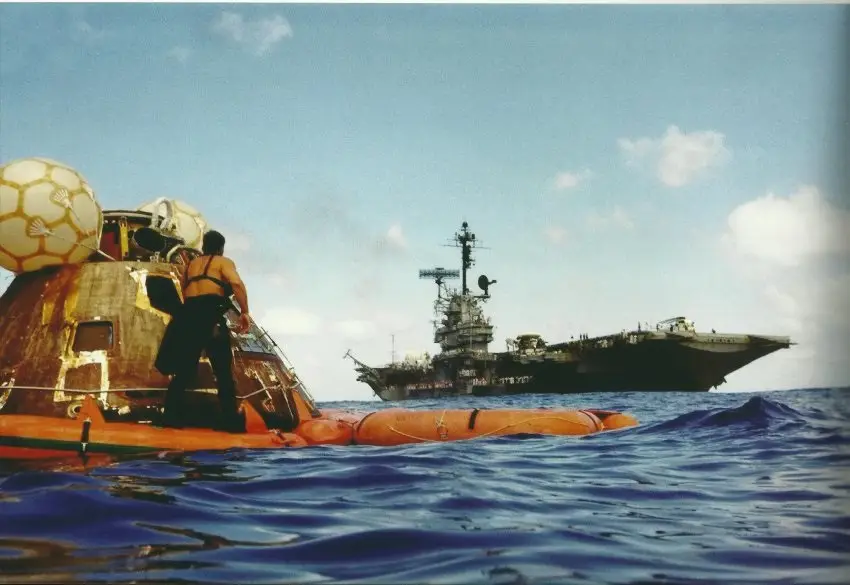
The Hornet Museum Sea King helicopter (BuNo 148999) has a storied Navy record. Built in 1961, she spent most of her career on the east coast. In June 1965, she recovered the two astronauts from the Gemini IV mission. James McDivitt and Ed White had orbited the Earth 66 times in four days before splashing down in the Atlantic Ocean. The historical highlight of the mission was the first space walk by an American, during which Ed White floated free outside the spacecraft, tethered to it, for approximately 23 minutes.
Her final mission was the lead helicopter in the 1995 blockbuster film “Apollo 13” by Ron Howard. For this role, she was painted in the livery of the real Apollo 13 recovery helicopter onboard USS Iwo Jima (LPH-2). Afterward, she retired to the USAF Davis-Monthan aircraft boneyard in Arizona, still in her Apollo 13 movie paint scheme.
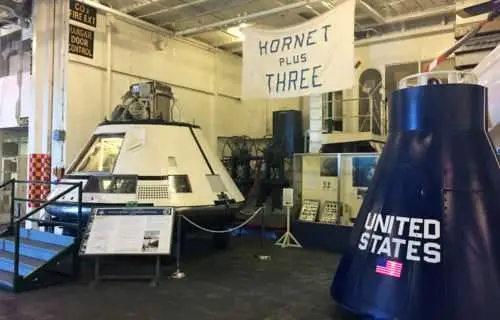
Ten years later, a member of the USS Hornet Museum recognized the Apollo CM decals still attached to her forward hull. In April 2005, she was placed on permanent loan to the USS Hornet Museum where she was restored to exhibit status.
Sikorsky Aircraft designed the all-weather SH-3 Sea King family of helicopters primarily for a ship-based anti-submarine warfare mission. The Sea King could carry both SONAR detection equipment and a variety of weapons used to attack submarines. It also performed admirably in anti-ship surveillance, search and rescue, cargo and personnel transport, communications, and airborne early warning roles. Sea Kings served with the U.S. Navy from 1961 until 2006.
SH-3’s became the primary astronaut recovery helicopter for all Gemini and Apollo space missions.
On Loan from the National Museum of Naval Aviation
Photos
- Shows her hoisting of one of the Gemini IV astronauts in 1965
- Shows her in the DM boneyard in 2005, preparing for shipment to USSHM
- Shows her being craned aboard the USSHM in 2006